I have been thinking a lot about trust lately, and not just in crypto. We live in a world where people are constantly being sold something: a new opportunity, a new platform, a new project, a new token, a new cause to support. After a while, you almost start to tune it all out, and I get it. Especially in crypto, where we have all seen projects show up out of nowhere, teams nobody can identify, huge promises, confusing tokenomics, and people talking about “community” when what they really mean is, “Please buy this.” That is exactly the kind of thing I did not want The Tide to become.
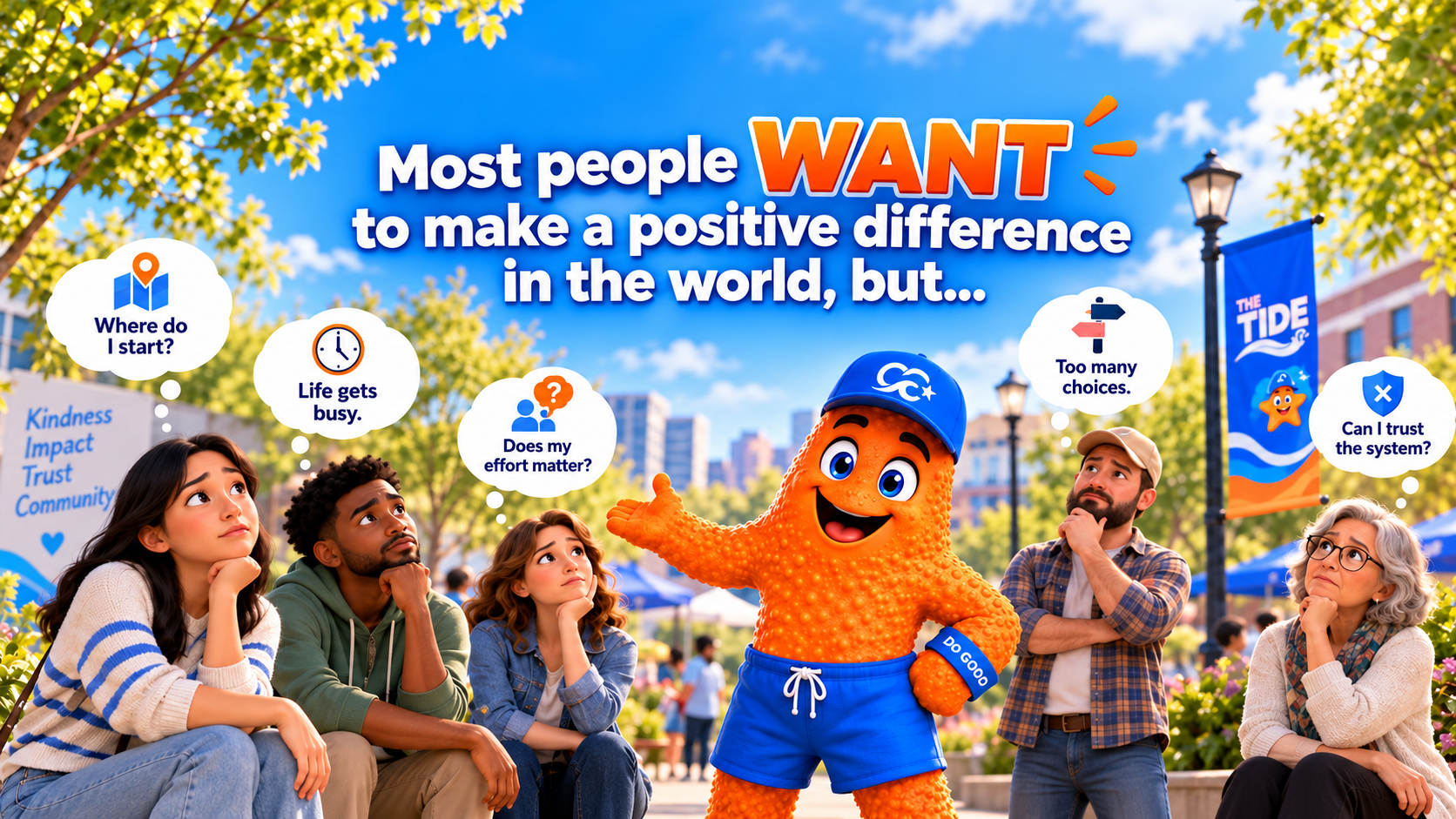
The funny thing is, The Tide did not really start with crypto at all. It started with something much simpler: the belief that most people really do want to make a positive difference in the world, but life gets busy, people do not always know where to start, they wonder whether their effort really matters, and they are not always sure which organizations or systems they can trust. People donate money and sometimes have no idea where it really went, and after a while that uncertainty can make even the most well-intentioned person hesitate. So I started asking myself a bigger question: what if there were a way to make doing good easier to participate in, easier to see, and much more transparent?
That question is really where The Tide came from, and eventually $STARFISH became part of the answer. Not the whole answer, but part of it, and that distinction matters to me. The Tide is the movement, while $STARFISH is a tool inside the movement designed to connect people, participation, community decisions, verified acts of kindness, and real-world impact in a way that can actually be seen and tracked.
Blockchain is part of that, but not because the word “blockchain” sounds impressive. It is useful because it gives us something traditional systems often do not: a public record. Transactions can be viewed, wallets can be viewed, token supply can be examined, and the movement of funds can be followed. That does not mean blockchain magically solves the trust problem, because people can still make bad decisions, projects can still fail, and people can still mislead others. Technology does not replace character, but transparency can make it much easier for people to verify what is actually happening.
That is why one of the ideas I keep coming back to with The Tide is very simple: do not just trust us, watch us. Watch what we say, watch what we do, watch where funds go, watch how Wave Partners are selected, watch the wallets, watch the transactions, and ask questions along the way. If The Tide is going to become what I believe it can become, trust cannot be something we ask people to hand us on day one; it has to be earned over time through consistency, transparency, and action.
That is also why I love the Wave Partner concept so much. Each month, the community gets to help choose an organization doing meaningful good in the world, and that organization becomes the current Wave Partner. During that month, the IMPACT Fees generated through $STARFISH activity are directed to that Wave Partner after applicable costs. To me, that is where this becomes really interesting, because now activity inside a digital ecosystem can create impact outside of it, connecting two worlds that are usually completely separate.
Then there are the acts of kindness themselves, which might honestly be my favorite part of the entire project. Kindness does not have to be some enormous, life-changing gesture. Sometimes it is helping somebody carry something, buying someone a meal, checking on a neighbor, volunteering, cleaning up a community space, or simply helping someone who needs a hand. Most of those things will never make the news and nobody gets famous for doing them, but they still matter. When enough people start doing small things consistently, those small things stop feeling small, and that is the entire idea behind The Tide: small acts can create waves.
Tomorrow, $STARFISH launches, and I am probably more excited than I can put into words. At the same time, I am very aware that tomorrow is not some magical finish line; it is the beginning. There will be things we learn, things we improve, and probably things we realize we could have done better, and that is normal. What matters to me is that the mission stays intact: build something people can participate in, build something transparent, build something that encourages people to do good, and build something where technology actually serves a purpose beyond the technology itself.
So if you are skeptical, that is okay. In fact, I would rather you look into it, ask questions, read the details, follow what happens, and make up your own mind based on what you can actually see. Do not believe something simply because I said it, because that is kind of the point: trust should not be demanded, it should be earned.
🌊 Small Acts of Kindness. Endless Waves.
The Tide | $STARFISH